

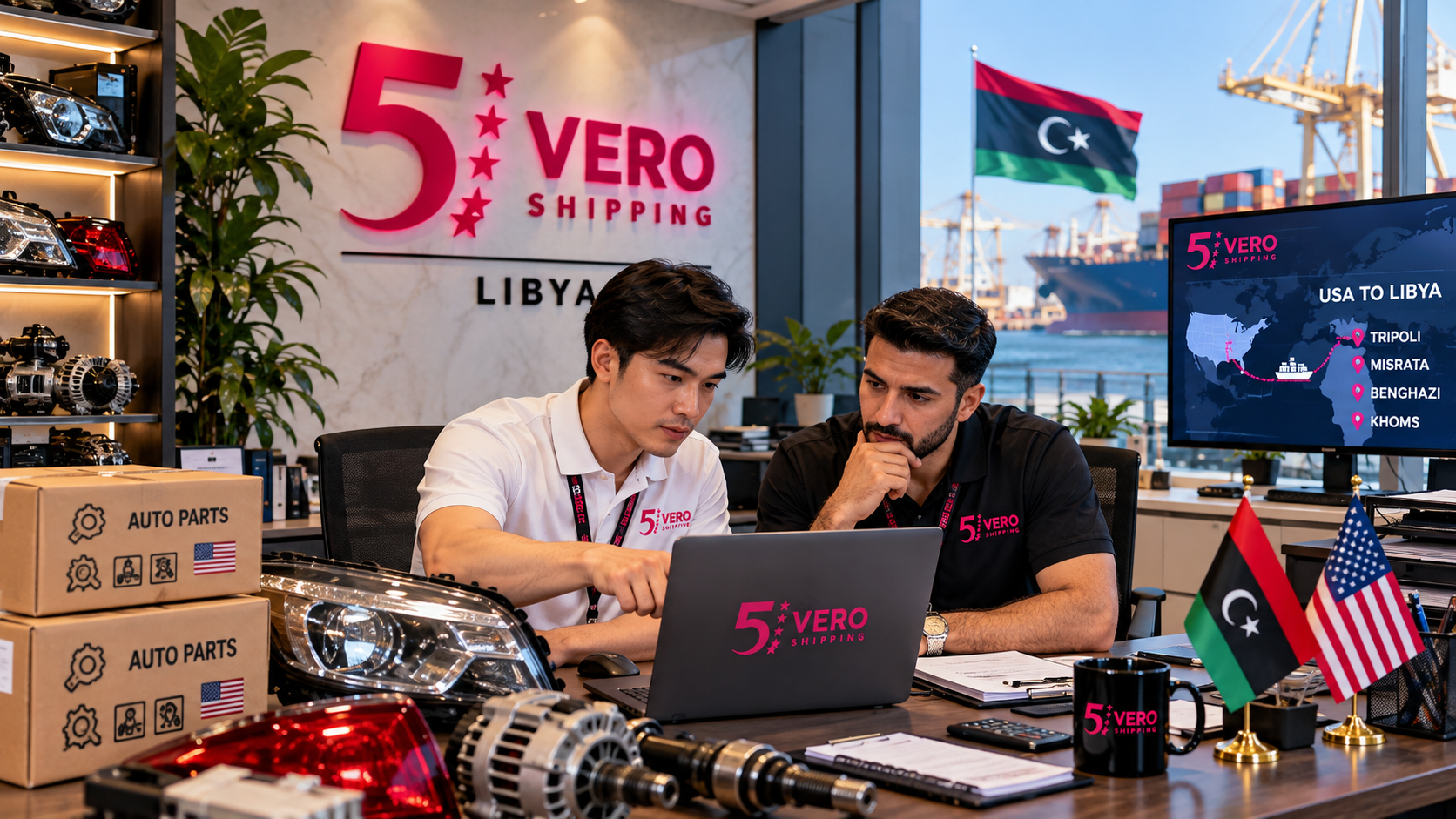
USA Auto Parts for Libya: From American Suppliers to Libyan Dealers
10 Oct 2026
USA Auto Parts for Libya: From American Suppliers to Libyan Dealers
For Libyan auto parts dealers, the United States is more than a market for buying complete vehicles.
It is also one of the largest sources of **used auto parts, engines, transmissions, body parts, headlights, electronic components, SUV and pickup parts, and specialized EV and hybrid components**.
For a professional dealer in **Tripoli, Misrata, Benghazi, Al Khums or another Libyan automotive market**, the biggest opportunity is not simply finding one inexpensive part in America.
The real opportunity is building a reliable supply chain:
**U.S. Supplier → Pickup → U.S. Inland Transportation → Receiving → Consolidation → Packing → Container Loading → Ocean Shipping → Libya**
VERO Shipping can coordinate the U.S. logistics and international shipping side for eligible automotive cargo, helping Libyan businesses connect purchases from American suppliers with containerized transportation to Libya.
Businesses already importing complete vehicles can also read VERO's complete guide to shipping cars from the USA to Libya and understanding the major costs involved. [Vero Shipping](https://veroshipping.com/NewsDetails.aspx?id=208\&utm_source=chatgpt.com)
---
## 1. Why the USA Is Important for Libyan Auto Parts Dealers
Libya has a large market for imported vehicles, including American-market SUVs, pickup trucks, sedans and damaged vehicles purchased for repair and resale.
Every imported vehicle eventually creates demand for replacement components.
A dealer may need:
- Engines
- Transmissions
- Headlights
- Taillights
- Bumpers
- Doors
- Hoods
- Fenders
- Suspension components
- Electronic modules
- Cameras and sensors
- Interior components
- Cooling-system parts
- EV and hybrid components
The United States has an enormous automotive recycling and spare-parts industry.
Instead of depending entirely on whatever inventory happens to be available locally, Libyan dealers can develop relationships with American suppliers and purchase according to actual market demand.
---
## 2. Don't Think About One Part — Think About a Supply Chain
This is where professional dealers should think differently from individual buyers.
Imagine a Libyan spare-parts company purchases:
**8 headlights in New Jersey**
**3 engines in Georgia**
**6 transmissions in Texas**
**20 electronic modules from another supplier**
**Body parts from a salvage yard**
Sending every purchase independently can create unnecessary transportation and handling costs.
A better strategy may be to coordinate eligible purchases through a planned U.S. logistics process.
VERO's guide to USA logistics from seller pickup to the export stage explains how the American side of an international automotive shipment can involve pickup, inland transportation, receiving, documentation, consolidation and export preparation. [Vero Shipping](https://veroshipping.com/NewsDetails.aspx?id=333\&utm_source=chatgpt.com)
For a parts dealer, the same principle is important:
**control the American side before worrying about the ocean voyage.**
---
## 3. What Auto Parts Can Be Purchased in America?
The American market offers components for an enormous range of vehicles.
For Libya, particularly interesting categories can include parts for:
**Toyota, Lexus, Ford, Chevrolet, GMC, Cadillac, Jeep, Dodge, RAM, Nissan, Hyundai, Kia, BMW, Mercedes-Benz, Tesla and other popular brands.**
But a professional importer should not buy randomly.
The first question should always be:
**What sells in my market?**
A $100 component that remains on the shelf for two years may be a worse investment than a $500 component that sells every month.
The best import strategy begins with demand in Libya, not simply low prices in America.
---
## 4. Pickup Truck and SUV Parts Can Be an Important Category
Libyan buyers have strong interest in SUVs and pickup trucks.
That creates opportunities for businesses specializing in components for vehicles such as:
**Toyota Tundra, Toyota Land Cruiser, Lexus SUVs, Ford F-Series, Chevrolet Silverado, GMC Sierra, RAM pickups, Chevrolet Tahoe and GMC Yukon.**
Parts may include:
- Front body components
- Headlights
- Taillights
- Grilles
- Mirrors
- Suspension
- Engines
- Transmissions
- Interior components
- Electronic modules
However, size matters.
A large bumper or hood may be inexpensive to purchase but consume significant cargo space.
This is why dealers should compare **purchase price against landed logistics cost**, not purchase price alone.
---
## 5. Where Can Libyan Dealers Buy Parts in America?
Potential sources include:
**Auto dismantlers, salvage yards, used-parts warehouses, dealerships, wholesalers, recyclers, specialized online sellers and private automotive suppliers.**
Some dealers may also purchase complete damaged vehicles specifically for dismantling.
But there is an important difference between:
**buying a complete vehicle for export**
and
**buying individual components from multiple sellers.**
Complete vehicles have their own ownership-document and export procedures. Parts shipments require accurate commercial descriptions, packing information and cargo details.
For international customers purchasing automotive products throughout the United States, VERO explains the importance of choosing a logistics provider that understands the complete export process in 12 things to check before choosing a U.S. international shipping company. [Vero Shipping](https://veroshipping.com/NewsDetails.aspx?id=234\&utm_source=chatgpt.com)
---
## 6. Supplier Location Can Change Your Profit
America is a very large country.
This sounds obvious, but it is one of the most important points for a Libyan importer.
Suppose two suppliers offer the same transmission:
**Supplier A: $1,000**
**Supplier B: $1,100**
Supplier A appears cheaper.
But Supplier A may be hundreds of miles farther from the planned receiving location.
After inland transportation, Supplier B could actually produce the lower landed cost.
VERO coordinates U.S. vehicle logistics through major American export regions, including areas around **New Jersey, Savannah, Houston and Los Angeles**, depending on the shipment and destination.
VERO's U.S. storage and handling guide also describes operations involving locations in Savannah, New Jersey, Texas and Los Angeles. Read how VERO coordinates receiving, handling and export preparation in the United States. [Vero Shipping](https://veroshipping.com/NewsDetails.aspx?id=232\&utm_source=chatgpt.com)
For parts businesses, the lesson is simple:
**check supplier location before buying.**
---
## 7. Consolidating Purchases from Multiple U.S. Suppliers
Consolidation is where a B2B parts operation can become more efficient.
A Libyan company might buy from five different American suppliers during the same month.
Instead of treating every order as an independent international shipment, eligible cargo may potentially be coordinated into a larger shipment.
The process can look like this:
**Supplier A**
**Supplier B**
**Supplier C**
↓
**U.S. Receiving / Logistics Coordination**
↓
**Consolidation & Packing**
↓
**Container Loading**
↓
**Ocean Freight**
↓
**Libya**
Whether consolidation is suitable depends on the actual cargo.
Before arranging pickup, provide:
**Supplier ZIP code + Description + Quantity + Dimensions + Weight + Value + Photos**
Any battery, fluid, chemical or potentially regulated component must also be clearly identified.
---
## 8. Build the Container Around Profitable Inventory
A professional dealer should think about container space as inventory space.
Large low-value components can consume significant volume.
Smaller high-value components may provide a better value-to-space ratio.
This does not mean large parts should never be imported.
It means the container should be planned intelligently.
For example, a shipment might contain a combination of:
**engines + transmissions + headlights + electronic components + properly packed body parts**
rather than filling valuable space without considering resale value.
VERO has extensive experience with containerized automotive logistics. Its guide to container shipping, cargo protection and professional loading practices explains why container planning is important for automotive shipments. [Vero Shipping](https://veroshipping.com/NewsDetails.aspx?id=38\&utm_source=chatgpt.com)
---
## 9. Engines and Transmissions Need Proper Preparation
Engines and transmissions can be attractive products for professional parts dealers because of their value and demand.
But they are also heavy.
Before arranging transportation, VERO should receive accurate information about the cargo:
**Exact description**
**Supplier location**
**Weight**
**Dimensions**
**Photographs**
**Condition**
**Packaging**
Any remaining fluids or other regulated characteristics must be disclosed.
Never tell a supplier simply:
**“Send it to the warehouse.”**
First confirm the receiving and transportation requirements.
A poorly prepared heavy component can create handling problems, additional costs or delays.
---
## 10. Body Parts Need Different Planning
Body parts create another challenge: **volume**.
A bumper may not be particularly heavy, but it occupies significant space.
The same applies to:
**doors, hoods, fenders, trunk lids and large interior panels.**
These items also need protection against:
- Scratching
- Bending
- Impact
- Pressure from other cargo
A Libyan dealer purchasing large quantities of body components should therefore consider packaging and container utilization before buying.
Buying cheap body parts is not useful if poor packing damages them during transportation.
---
## 11. Headlights and Electronics Can Be Attractive Inventory
Modern headlights can be valuable automotive components.
The same applies to:
**control modules, cameras, sensors, displays and certain electronic components.**
They take relatively little space compared with large body parts, but their value can be much higher.
However, compatibility becomes critical.
Two headlights may look almost identical while having different:
- Part numbers
- Connectors
- Control modules
- Model-year compatibility
- Trim compatibility
- U.S.-specification features
Always request the **OEM part number** and donor vehicle information when available.
For expensive electronics, photographs of labels and connectors should be obtained before purchase.
---
## 12. Used Parts Need Condition Verification
American salvage yards can offer valuable inventory, but used does not automatically mean good.
Ask where the donor vehicle was damaged.
A headlight removed from a rear-impact vehicle may have a very different risk profile from a headlight removed from a severe front-impact vehicle.
Electronics from flood-damaged vehicles require particular caution.
Before paying, request:
**Detailed photos + Part number + Donor VIN where available + Condition + Damage disclosure**
For expensive components, documentation should be saved.
Professional purchasing is not simply finding the lowest online price.
It is reducing the chance of importing unusable inventory.
---
## 13. EV & Hybrid Parts Create a New Business Opportunity
Libya's automotive market will continue evolving.
As more hybrid and electric vehicles enter regional markets, specialized replacement components can become another opportunity for spare-parts businesses.
Potential components include:
- Inverters
- Electric motors
- Charging ports
- Onboard chargers
- DC/DC converters
- Battery cooling components
- High-voltage cables
- Electronic modules
- Sensors
- Displays
But dealers should distinguish these ordinary components from **high-voltage lithium batteries**.
A motor controller is not automatically handled the same way as a complete EV battery.
---
## 14. Lithium Batteries Require Separate Review
A complete EV or hybrid battery should never simply be declared as:
**“Auto Parts.”**
Lithium batteries can fall under dangerous-goods transportation requirements.
Battery condition is especially important.
A damaged, defective, burned, leaking or flood-affected battery can present substantially different transportation risks.
Before purchasing or sending any high-voltage battery, provide VERO with:
**Battery type + Condition + Photos + Weight + Dimensions + Supplier location + Available documentation**
The shipment can then be reviewed against current carrier and transportation requirements.
Do not conceal batteries inside boxes, vehicles or other cargo.
---
## 15. Packing Is Part of the Business
Many importers focus heavily on buying and freight rates but underestimate packaging.
For a B2B parts company, packaging affects profitability.
Consider a shipment containing:
**4 engines, 6 headlights, 10 electronic modules, 3 bumpers and several suspension components.**
Each category needs different protection.
Heavy items need stable support.
Fragile lights need impact protection.
Electronics need appropriate packaging.
Large painted body components need protection against scratches.
The objective is not simply to fit everything into a container.
The objective is for the inventory to reach Libya in commercially usable condition.
---
## 16. Accurate Cargo Descriptions Matter
Commercial shipping documents should accurately describe what is being transported.
Depending on the transaction and shipment, documentation can include:
- Commercial invoice
- Packing list
- Seller information
- Buyer/consignee information
- Cargo description
- Quantity
- Value
- Shipping documents
- Export documentation where applicable
Do not use vague descriptions when more accurate information is available.
And never intentionally misdescribe regulated cargo.
VERO Shipping operates as an FMC-registered NVOCC for foreign commerce. Customers can read why working with an FMC-registered NVOCC matters for international shipments from the United States. [Vero Shipping](https://veroshipping.com/NewsDetails.aspx?id=335\&utm_source=chatgpt.com)
---
## 17. Choosing the Right Libyan Port
The best arrival port is not automatically the same for every Libyan business.
Depending on current carrier service and booking availability, importers may evaluate ports serving different regions of Libya.
For example:
**Tripoli** may be relevant for businesses in western Libya.
**Misrata** can be important for dealers operating around Misrata and surrounding areas.
**Benghazi** may be more practical for businesses serving eastern Libya when suitable service is available.
**Al Khums** may also be considered when an appropriate routing is available.
But port selection must be confirmed for the actual shipment.
VERO's dedicated comparison of Tripoli, Misrata and Benghazi for shipments from the United States to Libya explains why the best port depends on current sailing availability, destination location and the complete logistics plan. [Vero Shipping](https://veroshipping.com/NewsDetails.aspx?id=343\&utm_source=chatgpt.com)
---
## 18. Don't Choose a Port Based Only on Ocean Freight
Suppose one Libyan port has a lower ocean rate.
That does not automatically make it the cheapest final solution.
The dealer should consider:
**Ocean freight + destination handling + local clearance arrangements + inland distance + final delivery location**
A dealer in eastern Libya may make a different decision from a dealer in Tripoli.
Likewise, a company with an established customs broker and receiving operation at one port may value operational consistency more than a small difference in freight.
VERO therefore recommends confirming the complete shipment plan rather than choosing a port based on one number.
---
## 19. Why Container Shipping Makes Sense for B2B Parts Dealers
For a professional spare-parts importer, container shipping can allow multiple eligible automotive components to move together as one planned commercial shipment.
The business can purchase inventory over time, coordinate eligible cargo and build a container around actual demand.
This is very different from repeatedly sending individual components internationally.
Containerized shipping can also provide physical protection and allow the importer to organize cargo more systematically.
VERO's Libya shipping guide identifies container shipping as one of the methods used for automotive transportation to the country. See VERO's USA-to-Libya shipping and cost guide for broader information about the route. [Vero Shipping](https://veroshipping.com/NewsDetails.aspx?id=208\&utm_source=chatgpt.com)
---
## 20. Calculate Landed Cost Before Buying
This is one of the most important rules in the entire business.
Do not calculate:
**American Purchase Price = My Cost**
Your real cost is closer to:
**Purchase Price + Supplier Charges + U.S. Inland Transportation + Packing/Handling + Export Logistics + Ocean Freight + Destination Expenses**
Then divide the total cost appropriately across your inventory.
This gives you a more realistic **landed cost**.
Only then can you calculate a meaningful selling price and profit margin.
---
## 21. Cheap Parts Can Become Expensive Parts
Consider two identical engines.
### Engine A
Purchase price: **$1,500**
### Engine B
Purchase price: **$1,700**
Engine A appears $200 cheaper.
But if Engine A is much farther from the receiving point and costs significantly more to transport, Engine B may actually be the better purchase.
Professional importers should therefore ask for the supplier ZIP code **before completing major purchases**.
This is particularly important for engines, transmissions and large body parts.
---
## 22. Build Relationships with Reliable U.S. Suppliers
The strongest business model is not constantly searching for random sellers.
Over time, a professional Libyan importer can develop a network of trusted suppliers for different categories.
For example:
**Supplier A → Engines**
**Supplier B → Transmissions**
**Supplier C → American pickup parts**
**Supplier D → Headlights**
**Supplier E → Electronics**
**Supplier F → EV/Hybrid components**
Once these relationships are established, purchasing becomes faster and quality becomes more predictable.
The logistics side can then be organized around a recurring procurement cycle.
---
## 23. From Occasional Orders to Monthly Containers
A small importer may begin with several purchases.
As sales grow, the business can move toward a planned monthly procurement strategy.
For example:
**Week 1:** Purchase high-demand inventory.
**Week 2:** Additional suppliers dispatch eligible cargo.
**Week 3:** Receiving, verification and consolidation.
**Week 4:** Packing and shipment planning.
The exact timing depends on suppliers, cargo and sailing schedules, but the principle is important:
**turn random purchases into a system.**
This is how logistics can support business growth instead of simply moving boxes.
---
## 24. Work with a Logistics Company That Understands Automotive Cargo
Automotive logistics has characteristics that ordinary general cargo may not.
A shipment might contain:
**heavy mechanical components + fragile lights + electronics + oversized body parts + regulated components.**
Each needs to be identified and handled appropriately.
VERO Shipping specializes in automotive logistics from the United States and coordinates inland transportation, receiving, export preparation, container loading and international ocean transportation depending on the shipment.
International customers can also use VERO's online shipping system to follow vehicle and container shipment information where applicable. [Vero Shipping](https://veroshipping.com/NewsDetails.aspx?id=228\&utm_source=chatgpt.com)
---
# Frequently Asked Questions
### Can VERO ship auto parts from the USA to Libya?
VERO can review logistics options for eligible automotive parts shipments from the United States to Libya. The exact solution depends on cargo type, volume, weight, supplier location, packaging and current carrier availability.
### Can you collect parts from several U.S. suppliers?
Depending on the supplier locations and cargo, VERO can review U.S. inland transportation and consolidation options.
### Can you ship engines and transmissions?
Potentially, subject to the exact cargo condition, preparation and shipping requirements. Send supplier location, photographs, dimensions, weight and full cargo details before dispatch.
### Can you ship used body parts?
Eligible used automotive parts may be reviewed for shipment. Proper packaging is particularly important for large or fragile body components.
### Can you ship Toyota Tundra, Ford, Chevrolet and GMC parts?
VERO's service is not limited to one vehicle brand. Shipping feasibility depends on the specific components rather than simply the vehicle manufacturer.
### Can you ship Tesla or hybrid parts?
Eligible EV and hybrid components may be possible, but lithium batteries require separate review.
### Can I ship an EV battery as normal auto parts?
No assumption should be made that a high-voltage battery can move as ordinary auto parts. Send complete battery details to VERO before purchasing or dispatching it.
### Which Libyan port should I use?
It depends on your location, current carrier service and the shipment. Tripoli, Misrata, Benghazi or Al Khums may be evaluated depending on current availability. The final port should be confirmed before shipment.
### Does VERO handle customs clearance inside Libya?
Do not assume destination customs clearance or inland delivery is included. VERO's current Libya vehicle content describes its core Libya service as port-to-port, so any additional destination service should be confirmed separately in writing. [Vero Shipping](https://veroshipping.com/NewsDetails.aspx?id=343\&utm_source=chatgpt.com)
### What information should I send VERO for an auto-parts quote?
Send:
**Supplier ZIP Code + Part Description + Quantity + Weight + Dimensions + Photos + Cargo Value + Preferred Destination in Libya**
Clearly identify any batteries or potentially regulated cargo.
---
# Build Your USA-to-Libya Auto Parts Supply Chain with VERO Shipping
For a Libyan auto-parts dealer, the United States can provide much more than occasional bargains.
It can become a **long-term source of automotive inventory**.
The key is to manage the complete chain:
**Choose the Right Parts → Verify Suppliers → Check U.S. Location → Coordinate Pickup → Consolidate Eligible Cargo → Pack Correctly → Load the Container → Ship to Libya**
Whether your business specializes in **engines, transmissions, American pickup parts, headlights, body components, electronics, EV parts or hybrid components**, planning the logistics before purchasing can help control costs and reduce unnecessary problems.
**VERO SHIPPING — USA TO LIBYA**
**U.S. Inland Transportation | Automotive Cargo | Consolidation | Container Loading | Export Logistics | Ocean Freight**
**For auto-parts dealers, workshops, garages and automotive businesses across Libya.**


