

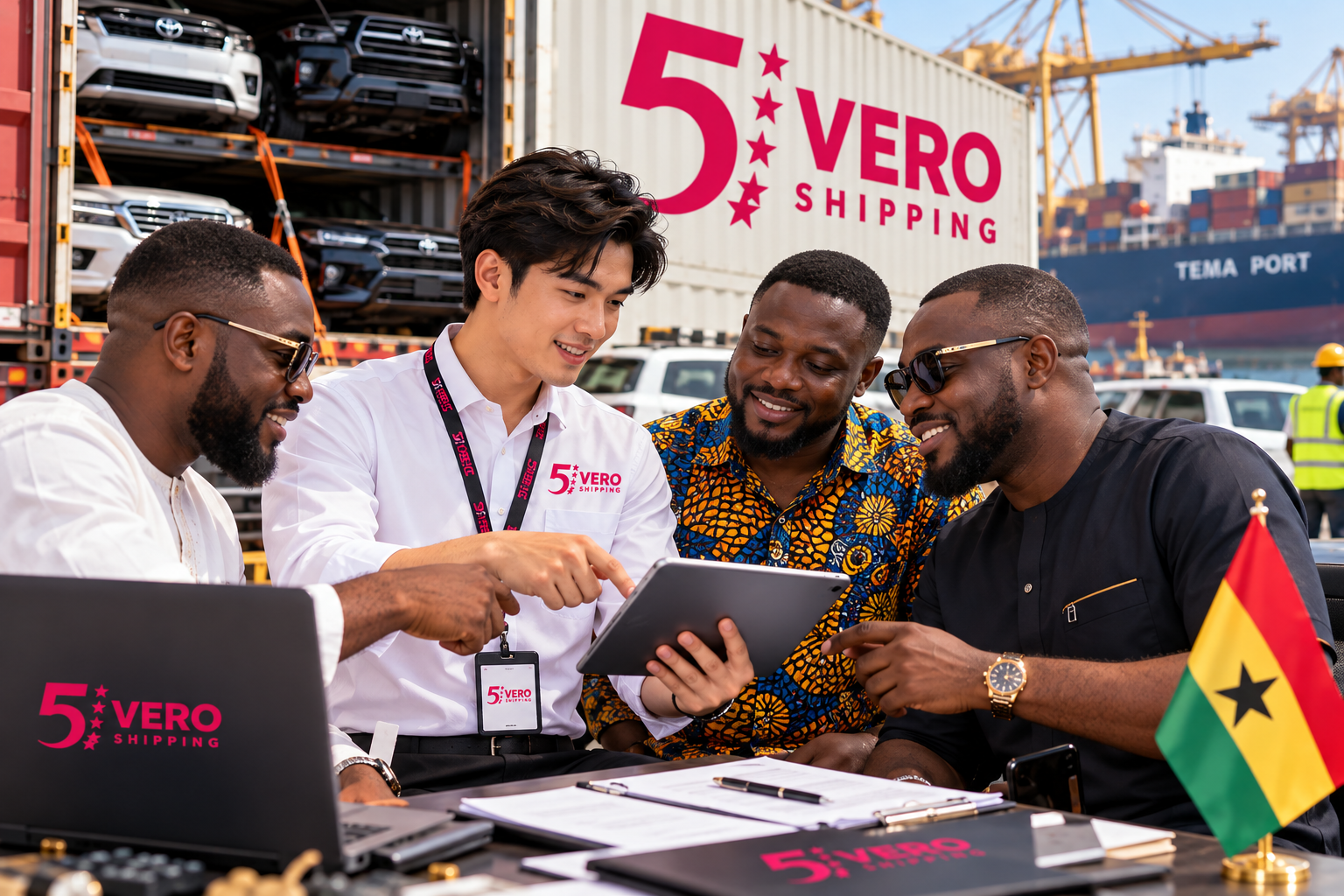
From One Container to a Monthly Business: A USA-to-Ghana Shipping Strategy for Car Dealers
10 Oct 2026
From One Container to a Monthly Business: A USA-to-Ghana Shipping Strategy for Car Dealers
For many Ghanaian car dealers, importing vehicles from the United States begins with a simple transaction: find a good vehicle, buy it, arrange transportation, and ship it to Tema.
But building a profitable vehicle-import business requires a different approach.
Instead of asking:
**“How do I ship this car to Ghana?”**
A growing dealer should eventually ask:
**“How do I build a repeatable system that allows me to ship vehicles from the USA to Ghana every month?”**
That difference is important.
A dealer who purchases vehicles randomly may constantly wait for titles, pay unnecessary inland transportation, leave vehicles sitting in storage, or delay an entire container because the final vehicle is not ready.
A dealer operating a monthly shipping program thinks differently.
The business becomes a continuous pipeline:
**Buying → U.S. Inland Transportation → Receiving → Documentation → Container Planning → Loading → Ocean Shipping → Tema → Next Container**
VERO SHIPPING works with international vehicle buyers and dealers who need to coordinate multiple vehicles purchased across the United States. Understanding the complete USA vehicle shipping process from seller pickup to export is an important first step toward building a scalable Ghana import operation.
---
## 1. Stop Thinking About One Vehicle at a Time
A small importer may evaluate every purchase individually.
A professional dealer should look at the entire inventory pipeline.
Imagine that a Ghanaian dealer purchases:
- Vehicle A in New Jersey
- Vehicle B in Georgia
- Vehicle C in Texas
- Vehicle D in Pennsylvania
Buying four vehicles does not automatically mean you have a container ready to ship.
Each vehicle may have a different:
- Pickup date
- Inland transportation cost
- Title status
- Vehicle size
- Mechanical condition
- Arrival date at the export facility
The objective is therefore not simply to own four vehicles.
The objective is to have the **right combination of export-ready vehicles available at the right time**.
VERO has a dedicated guide explaining how many cars may fit inside a 40ft container from the USA to Tema, because vehicle dimensions and combinations can directly affect container planning.
---
## 2. Build a Monthly Purchasing Target
If your objective is one container every month, purchasing should not happen randomly.
Create a buying target.
For example, instead of waiting until the end of the month and trying to purchase several cars quickly, the dealer can spread purchases throughout the month.
The exact number depends on vehicle size, container configuration and your sales strategy.
The important principle is consistency.
Your purchasing team should know:
**How many vehicles are needed?
Which models sell well in Ghana?
What maximum landed cost is acceptable?
Which vehicles are already in the U.S. pipeline?
Which vehicles are waiting for titles?
Which cars can complete the next container?**
This turns auction buying into inventory management.
---
## 3. Buy for Ghanaian Demand—not Just Auction Price
The cheapest vehicle at Copart or IAA is not necessarily the most profitable vehicle in Ghana.
Dealers should consider the resale market before bidding.
A vehicle might appear inexpensive because of:
- Heavy collision damage
- Flood history
- Missing components
- Mechanical problems
- Expensive replacement parts
- Difficult title documentation
- High transportation distance
- Unusual specifications
Your profit starts with the purchase decision.
Before bidding, calculate approximately:
**Purchase Price + Auction Fees + Inland Transportation + Export/Shipping Costs + Destination Expenses + Repair Cost = Estimated Landed Cost**
Then compare that figure with the realistic resale value in Ghana.
VERO's 15 checks before buying a Copart salvage car for Ghana explains several of the vehicle, title, damage and logistics factors that should be reviewed before placing a bid.
---
## 4. U.S. Auction Location Can Change Your Profit
Two identical vehicles can sell for similar prices but produce very different final costs.
Why?
**Location.**
The United States is enormous.
A vehicle located close to an export operation may cost significantly less to move than a vehicle located far inland.
Dealers purchasing several cars every month should therefore evaluate the auction location **before bidding**, not afterward.
VERO's guide to the best U.S. auction locations for Ghana car importers explains how distance from the auction to the export operation can influence inland transportation cost and timing. [Vero Shipping](https://veroshipping.com/NewsDetails.aspx?id=322\&utm_source=chatgpt.com)
A $300 saving at auction can quickly disappear if the vehicle requires expensive long-distance transportation.
---
## 5. Group Purchases More Intelligently
A monthly importer should begin recognizing geographic patterns.
If several attractive vehicles are available in Georgia, for example, purchasing compatible inventory within the same general region may improve logistics efficiency compared with buying vehicles scattered randomly across the country.
That does not mean you should avoid a profitable vehicle simply because it is farther away.
It means inland logistics must become part of your buying calculation.
Professional dealers should know approximately:
**Auction Location → Pickup Cost → Export Facility → Expected Arrival**
before approving the purchase.
This is one of the biggest differences between occasional importing and professional importing.
---
## 6. Never Let One Vehicle Control the Entire Container
One of the biggest problems in multi-car shipping is waiting for one vehicle.
Suppose three vehicles are:
**Received + Documented + Export Ready**
but the fourth vehicle has a delayed title.
The dealer may lose valuable time waiting.
This is why professional importers should maintain a pipeline containing more than the exact minimum number of vehicles required for one shipment.
If Vehicle D develops a documentation problem, Vehicle E may potentially become part of the next container instead, subject to size, documentation and loading suitability.
Your inventory pipeline gives you flexibility.
---
## 7. Title Readiness Should Be Tracked Separately
A vehicle physically arriving at the export facility does not automatically mean it is ready for international export.
The vehicle and its documentation are two separate parts of the process.
For every car, your internal list should show something similar to:
**Purchased → Paid → Released → Picked Up → Received → Title Received → Export Ready → Assigned to Container**
This simple system helps prevent confusion.
A dealer managing 15 or 20 vehicles should be able to identify immediately which units are ready and which units require attention.
---
## 8. Storage Is Part of Inventory Planning
Vehicles do not always arrive together.
One car may reach the facility early while another is still waiting for auction release or transportation.
VERO currently explains its 30-day free vehicle storage policy at its U.S. yards. Dealers should understand storage terms because unnecessary waiting can eventually affect shipment economics. [Vero Shipping](https://veroshipping.com/NewsDetails.aspx?id=57\&utm_source=chatgpt.com)
Storage should not be treated simply as parking.
It should be treated as part of the dealer's inventory cycle.
The longer money remains tied up in an unshipped vehicle, the longer it takes for that capital to return to the business.
---
## 9. Cash Flow Matters as Much as Shipping Cost
A profitable monthly shipping program requires working capital.
Consider the sequence:
**Buy Vehicle → Pay Auction → Pay Transportation → Wait for Export → Ship → Ocean Transit → Arrival in Tema → Sell Vehicle → Recover Capital**
Your money may remain tied up throughout this entire cycle.
This is why dealers should avoid using all available cash to purchase vehicles without leaving enough liquidity for:
- Auction payments
- Inland transportation
- Shipping expenses
- Unexpected costs
- Repairs
- Destination expenses
- The next round of purchases
A business can show a profit on paper and still have cash-flow problems.
---
## 10. Measure Profit Per Vehicle, Not Just Container Freight
Dealers frequently focus on one number:
**Ocean freight.**
But the cheapest freight quotation does not necessarily create the highest profit.
The correct calculation should include the complete logistics chain.
VERO's guide to car shipping costs from the USA to Ghana explains several factors that can affect the overall transportation cost, including vehicle location, size, shipping method and number of vehicles. [Vero Shipping](https://veroshipping.com/NewsDetails.aspx?id=55\&utm_source=chatgpt.com)
For a dealer, the more useful calculation is:
**Total Container-Related Cost ÷ Number of Vehicles + Individual Vehicle Costs**
Then calculate the expected margin on each unit.
You may discover that one vehicle produces an excellent margin while another consumes too much container space relative to its resale profit.
---
## 11. Vehicle Size Must Be Part of the Buying Decision
Four vehicles do not necessarily equal four standard sedans.
SUVs, pickup trucks and oversized vehicles change the loading equation.
A dealer should therefore avoid purchasing the final vehicle for a container without considering the dimensions of the vehicles already waiting.
For example, if you already have several large SUVs, adding another oversized vehicle may affect the planned loading configuration.
This is why VINs, makes and models should be shared with the logistics team before final container planning.
---
## 12. Non-Running Cars Need Additional Planning
Salvage vehicles can offer attractive buying opportunities, but they may also create additional logistics challenges.
A non-running vehicle may have:
- Locked wheels
- Broken suspension
- Missing keys
- Steering damage
- Severe collision damage
- Mechanical failure
VERO's guide to shipping non-running cars from U.S. auctions to Ghana explains why these vehicles require more planning for pickup, handling and container loading. [Vero Shipping](https://veroshipping.com/NewsDetails.aspx?id=321\&utm_source=chatgpt.com)
For monthly dealers, this matters because one difficult vehicle can affect the timing of an otherwise ready shipment.
---
## 13. Create a “Next Container” List
A simple but effective strategy is to maintain two lists.
**Container A — Ready / Almost Ready**
These are the vehicles expected to ship next.
**Container B — Pipeline**
These are newer purchases still being transported, documented or prepared.
Once Container A leaves, Container B moves forward.
Meanwhile, you continue buying vehicles for Container C.
This creates continuity.
Instead of:
**Buy → Wait → Ship → Start Again**
you create:
**Buy + Transport + Prepare + Ship + Buy Again**
with several stages operating simultaneously.
That is how an occasional importer begins behaving like a professional dealership.
---
## 14. Shipping Time Should Influence Inventory Decisions
A dealer's business plan should consider more than vessel transit.
The complete timeline can include:
- Auction release
- Vehicle pickup
- Inland transportation
- Receiving
- Title preparation
- Container planning
- Loading
- Export procedures
- Vessel schedule
- Ocean transit
- Arrival procedures
VERO's USA-to-Ghana shipping time guide explains why the total journey includes several stages before the vehicle reaches Tema. [Vero Shipping](https://veroshipping.com/NewsDetails.aspx?id=56\&utm_source=chatgpt.com)
Understanding this cycle helps dealers estimate when inventory may become available for resale.
---
## 15. Plan for Delays Before They Happen
No international shipping program can guarantee that every shipment will move exactly according to the original schedule.
Potential delays may occur because of:
- Late titles
- Auction release issues
- Inland transportation
- Documentation problems
- Vessel schedule changes
- Port congestion
- Transshipment
- Inspections
VERO has identified 12 delays that can affect vehicle shipping from the USA to Tema. [Vero Shipping](https://veroshipping.com/NewsDetails.aspx?id=236\&utm_source=chatgpt.com)
A monthly dealer should therefore build some flexibility into purchasing and inventory planning rather than promising customers unrealistic fixed arrival dates.
---
## 16. Track Every Vehicle by VIN
Once a dealer begins managing many vehicles simultaneously, WhatsApp messages and memory are not enough.
Every vehicle should have a clear identity throughout the process.
The VIN is the most reliable reference.
VERO's vehicle shipping and account management system is designed to help customers access available vehicle, shipment, invoice and account information, which becomes particularly useful for dealers managing multiple vehicles at the same time. [Vero Shipping](https://veroshipping.com/NewsDetails.aspx?id=245\&utm_source=chatgpt.com)
The larger your monthly volume becomes, the more important organized information becomes.
---
## 17. Turn Shipping Data Into Business Data
After several containers, start analyzing your own numbers.
For every vehicle record:
**Purchase Price
Auction Fees
U.S. Inland Cost
Shipping Allocation
Repair Cost
Destination Cost
Total Landed Cost
Selling Price
Gross Profit**
After 20, 30 or 50 vehicles, patterns become visible.
You may discover that:
- Certain models produce better margins.
- Certain auction locations create lower inland costs.
- Certain types of damage are more economical to repair.
- Some large vehicles consume too much shipping space.
- Some inexpensive auction purchases become expensive after logistics.
That information should influence future bidding.
---
## 18. The Goal Is Faster Capital Rotation
The purpose of monthly shipping is not simply to say:
**“We ship one container every month.”**
The real objective is to rotate capital efficiently.
A successful cycle looks like:
**Purchase → Transport → Export → Tema → Sale → Reinvest**
The faster and more predictably that cycle operates, the easier it becomes to plan future inventory.
This is why logistics becomes part of the dealer's financial strategy.
---
## 19. Move From Reactive Shipping to Planned Shipping
An occasional importer reacts:
**“I have four cars. Can you ship them?”**
A professional dealer plans:
**“These vehicles are for the next container. These vehicles are for the following container. These titles are pending. These cars are currently in transportation. These are the models we are bidding on next week.”**
That is a completely different business model.
The shipping company is no longer contacted only after all vehicles have been purchased.
Logistics becomes part of the purchasing decision from the beginning.
---
## 20. Build a Long-Term USA-to-Ghana Logistics Relationship
When dealers import regularly, consistency becomes increasingly valuable.
A long-term logistics relationship allows both the dealer and shipping team to understand:
- Typical monthly volume
- Preferred vehicle categories
- Common auction locations
- Container requirements
- Documentation workflow
- Communication process
- Tema-bound shipping plans
The objective is to reduce unnecessary surprises and create a repeatable process.
VERO SHIPPING coordinates vehicle pickup, U.S. inland transportation, receiving, export preparation, container planning, professional loading and ocean-shipping arrangements for Ghana-bound vehicles.
---
# A Practical Monthly Workflow for Ghana Car Dealers
A dealer planning regular shipments can organize the business around a repeating cycle:
**Week 1:** Purchase the first vehicles and arrange pickup.
**Week 2:** Continue purchasing while the first vehicles move toward the export operation.
**Week 3:** Review vehicle arrivals, titles and container combinations.
**Week 4:** Finalize export-ready vehicles and coordinate the next available suitable shipment.
At the same time, purchasing for the **next container** can already begin.
The exact schedule will vary depending on auction releases, titles, inland transportation and current carrier availability.
The important idea is that the business never completely stops between containers.
---
# Frequently Asked Questions
### Can a Ghana dealer ship vehicles every month from the USA?
Yes, regular shipping can be organized when purchasing, inland transportation, documentation and container planning are managed as a continuous pipeline. Actual sailing availability and timing should always be confirmed for each shipment.
### Should I buy all vehicles from the same U.S. state?
Not necessarily. Good opportunities may exist across the United States. However, inland transportation should be calculated before purchasing because distance can materially affect landed cost.
### Should I wait until I have all the cars before contacting VERO?
No. For dealers planning multi-vehicle containers, communicating earlier can help with vehicle combination, inland planning and shipment readiness.
### What information should I send after purchasing a vehicle?
Send the VIN, make/model, exact pickup or auction location, vehicle condition and available documentation as early as possible.
### Can damaged or non-running vehicles be shipped?
Many can, but their exact condition must be reviewed because severe damage, locked wheels, missing components or other issues can affect transportation and loading.
### Is the lowest-priced auction car usually the most profitable?
No. Dealers should calculate the complete landed cost and estimated repair expense before determining potential profit.
### Does arriving at the U.S. export facility mean the vehicle is ready to ship?
Not always. Documentation and export readiness must also be confirmed.
### Does VERO guarantee a fixed monthly sailing date?
Shipping schedules and carrier availability can change. The appropriate current sailing should be confirmed when the vehicles and documentation are ready.
---
# From One Container to a Real Import Business
The transition from occasional importing to a professional monthly vehicle business does not happen simply by purchasing more cars.
It happens by creating a system.
**Buy strategically.
Calculate inland transportation before bidding.
Track every vehicle.
Monitor titles early.
Plan container combinations.
Control storage time.
Measure landed cost.
Protect cash flow.
Prepare the next container before the current one reaches Tema.**
For Ghanaian car dealers, the United States offers an enormous vehicle market—but purchasing opportunities alone do not create profit.
The competitive advantage comes from connecting purchasing, logistics, shipping and inventory management into one repeatable operation.
**VERO SHIPPING** can coordinate the U.S. logistics and international shipping stages for dealers building regular vehicle shipments from the USA to Tema, Ghana.
**USA → Ghana | Vehicle Pickup | Inland Transportation | Export Preparation | Container Loading | Ocean Shipping to Tema


